
Stop Wasting Time: The Complete Guide to Mastering ChatGPT Prompts from Scratch for Perfect Results
Master prompt engineering! Learn exactly how to write ChatGPT prompts from scratch. Stop guessing & start getting genius results instantly. Try our free AI prompt optimizer
now!
Generative AI models like ChatGPT, Claude, and Gemini have been hailed as the great productivity unlock of our generation. They promise to automate coding, draft marketing plans, create stunning images, and even manage our personal lives.
And yet, for many users, the reality is far less spectacular. Have you ever tried asking ChatGPT for something important, only to receive a vague, incorrect, or completely generic answer?
The frustrating truth is that Generative AI is only as good as the instructions you provide.
Most users interact with powerful LLMs (Large Language Models) like ChatGPT as if they are basic search engines. They type short, imprecise queries and are consistently disappointed by average results.
This guide is about to change that. You are not a generic user; you are about to become a Master Prompt Engineer.
In this definitive guide, we will decode the architecture of a perfect interaction. We will break down exactly how to move beyond basic questions and learn the structured, intentional language required to write ChatGPT prompts from scratch that yield genius-level results, every single time.

Image #1: Mastering the Digital Canvas. A modern professional intuitively translating complex thoughts into structured digital prompts, illustrating how intentional engineering unlocks hidden creative potential.
Part 1: The Core Philosophy – Why We Engineering (H2)
The fundamental reason most users receive “average” output from a genius model like ChatGPT is a lack of understanding of what Generative AI actually is.
ChatGPT is not a human. It does not have common sense. It has not read your previous thoughts. It operates based on mathematical probability, predicting the next best word based strictly on the context you provide.
A prompt is not just a question; it is the mandatorily prescribed logic boundary for that mathematical prediction. When you provide weak, associational input (e.g., “Write about coffee”), the model has vast probabilistic freedom, resulting in a generic, non-authoritative answer.
To write ChatGPT prompts from scratch that yield genius-level success, you must adopt the mindset of an engineer. You are not “asking,” you are engineering a context-bound instruction. Your goal is to narrow that mathematical freedom until there is only one logical result: spectacular success.
Part 2: The Core Anatomy – The Perfect 5-Part Blueprint (H2)
If you need professional, complex output, you can’t rely on intuition. You need a structured blueprint. Every masterpiece of prompt engineering, regardless of complexity, must adhere to this mandatory anatomical breakdown of a perfect instruction.
1. Persona/Domain Expertise (Who?)
Before you state the task, you must define the expertise level. Always assign the AI a specific role, expertise, or persona.
- Weak Input: “Write about sales.”
- Blueprint Input: “Act as a world-class VP of Sales with 20 years of experience scaling tech B2B startups from $1M to $50M ARR.”
2. Precise Task & Objective (What?)
Define the task clearly using precise verbs. Vague instruction guarantees vague output. Be specific about the core task, the expected output, and the intended purpose.
- Weak Task: “Explain our product.”
- Blueprint Task: “Analyze our new enterprise SaaS pricing page. Identify exactly how it fails against our competitors in value clarity. Generate a prioritized list of three specific, actionable copywriting tweaks to convert enterprise CIOs instantly.”
3. Comprehensive Context (Where & Why?)
This is where beginners always fail. You must provide the full strategic landscape. What is the background? Who is the audience? What is at stake?
- Blueprint Context: “We are launching in Q4. CIOs are fatigued by high cost but require strict security. Our unique value prop is a guaranteed 45% reduction in TCO (Total Cost of Ownership) while being SOC2 compliant. The audience is analytical, highly intelligent, and incredibly busy.”
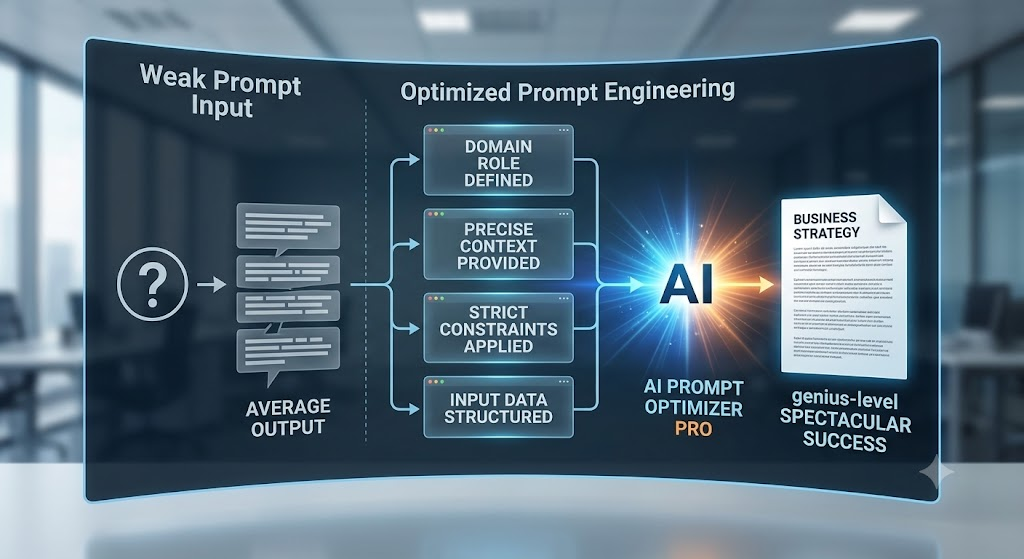
Image #2: Input vs. Architecture. A visual breakdown comparing imprecise prompt input (associational questioning) that leads to average results, versus the robust architecture of true prompt engineering (structural instructions), which anchors successful output.
4. Strict Constraints (The Steering Wheel)
You are the engineer. If you leave it up to the model, it will hallucinate generic, safe average responses. Constraints are your obligatory steer-wheel. Define precise tone, exact word length, formatting (HTML, JSON, markdown table), must-include elements, and must-avoid concepts.
- Weak Constraint: “Keep it professional.”
- Blueprint Constraint: “Present the prioritized list in a markdown table. Columns must be: [Suggested Tweak], [Expected CIO Benefit], [Prioritization rationale (High/Medium/Low)]. Use a highly professional, authoritative tone. Word limit: 300 words total.”
5. Delimited Input Data (The Information Source)
If you have complex data you need the AI to analyze, never paste it loosely. Use delimiters (triple quotes """ or bracket tags <<< <<<) to clearly separate your engineering instructions from the raw information.
Master Tip: Skip the Engineering Learning Curve
While learning to manually construct these blueprints is vital, the reality is that sometimes you have complex, high-stakes tasks and you need spectacular results now. For those moments, don’t waste time on trial and error. Beginners who require immediate expert output simply optimize your prompts for free using AI Prompt Optimizer Pro. This powerful tool instantly builds professional engineering structure—personas, context, and constraints—into your simple idea automatically, guaranteeing high-quality output on your very first try for ChatGPT, Claude, and Gemini.
Part 3: Pro Tips & Common Mistakes in Engineering (H2)
Talking to AI is not intuitive. It requires a specific declarative logic. Master prompt engineering by adopting these critical mindset shifts:
Common Mistakes to Avoid (The “Garbage In”)
- ❌ Treating AI Like Google: Google wants to assoicate. ChatGPT wants to be instructed. Don’t search; command.
- ❌ Being Vague or Polite: AI models lack feelings but struggle with subtext. Vague instructions (e.g., “Write a nicely phrased blog post”), gets vague output.
- ❌ Accepting the First Output: Beginners take the first draft. Engineers iterate. “I like section 1, but section 2 is too casual. Rewrite it for a scientific journal.”
- ❌ Using complex jargon unnecessarily: While literal, AIs get confused by jargon if simple, imperative sentences would be clearer.
Pro Tips for Genius Success (The “Master Class”)
- ITERATIVE DIALOGUE: The first prompt is just the blueprint. Use the dialog to criticize, refine, and enforce new constraints until you achieve perfection. Iteration is the core of prompt engineering.
- THE “ACT AS” COMMAND: This is the Single most effective strategy for beginners. Always establish the expertise domain. Act as a lawyer, Act as a master SEO copywriter, Act as a kindergarten teacher.
- FEW-SHOT PROMPTING: If you have a specific style, provide 1 or 2 high-quality examples of what you mean. The model will analyze the pattern perfectly.
- INSTANT OPTIMIZATION: Skip the engineering curve when you can. For critical tasks, guarantee professional logic by using a dedicated generator that automatically implements perfect structural design for you. Master prompt engineering by learning the blueprint, but always remember you can try our free AI prompt optimizer tool to convert weak thought into a structurally perfect engineering blueprint instantly.

Image #3: Results of Intentional Architecture. Mastery of prompt engineering logic. An inspired professional successfully organizing knowledge streams by providing strict anatomical boundaries (context, roles, constraints), yielding consistent flows of Creative Content, Specific Strategy, and Proven Solutions that can be scaled infinitely.
Conclusion: Engineering Your Spectacular Productivity Future (H2)
Artificial intelligence has promised to transform our lives, but you now have the conceptual key to that kingdom. True productivity with Generative AI is not a function of raw model intelligence; it is a direct function of the obligatory logical boundaries that you construct.
Mastering the language of context, constraints, domains, and deliberate iteration—the mandatory skills required to write ChatGPT prompts from scratch—is the most essential productivity skillset of the 21st-century digital landscape. You are no longer guessing; you are engineering.
By following the imperative checklist of successful interaction: establish domain role, prescribe precise context, define mandatory constraints, delimit input, and iterate on critique, you guarantee spectacular success and eliminate frustration.
Stop settling for average. Stop allowing the mathematical probability to dictate your output. Engineering your context means engineering your success. Master the logic of prompts today.
Unlock Genius Results Instantly: Try Our Free AI Prompt Optimizer
Why wait? You now know the blueprint of a perfect instruction. Put that knowledge to the mandatory test right now.
Optimize your prompts for free using AI Prompt Optimizer Pro. It’s instant, 100% free, and requires no credit card. Turn your generic, simple idea into a structurally sound engineering blueprint for ChatGPT, Claude, and Gemini in one click. Experience spectacular AI potential now.