
The Secret to Professional AI Text: How to Master Deep Prompts for Perfect Results.
Stop settling for bad AI output. Learn exactly how to write deep prompts to get professional results instantly. Stop guessing & read the ultimate guide!
Generative AI models like ChatGPT, Claude, Gemini, and Grok have been hailed as the ultimate productivity multipliers of our generation. They promise to automate coding, draft marketing plans, create stunning images, and streamline our lives.
And yet, for many users, the reality is less spectacular. Have you ever asked an AI for something important and received a vague, incorrect, or completely generic answer?
The single most common reason for failure in AI text generation isn’t the model—it’s your prompt.
The vast majority of users operate with what we classify as shallow prompts. They provide short, vague instructions and are consistently disappointed by average results. In contrast, professionals utilize deep prompts—engineered structures that define context, roles, constraints, and objectives with precision.
This guide is about to change your relationship with AI. We will decode the anatomy of an optimized instruction. You will learn how to stop guessing and start engineering context-bound blueprints that yield genius-level success, every single time.

Image #1: Mastering the Console. A modern professional intuitively translating complex thoughts into structured digital prompts, illustrating how intentional engineering unlocks hidden creative potential.
What is a Shallow Prompt? (The Problem) (H2)
We’ve all written them. A shallow prompt is a short, conversational, and non-authoritative instruction that lacks mandatory contextual structure. It provides the AI with too much probabilistic freedom, resulting in an output that is statistically likely, but professionally useless.
Shallow prompts suffer from The Ambiguity Trap. They are treated by the LLM as simple association questions rather than engineering blueprints.
Example of a Shallow Prompt (Input & Weak Output)
User Prompt (Input): “Write a short blog post about marketing.”
The resulting output is inevitable: a perfectly grammatically correct, generic summary of “modern digital strategies.” It has no soul, no unique value prop, no audience targeting, and no actionable advice. It is a “C-student” essay.
Why Shallow Prompts Fail Professional Requirements (H2)
If your goal is only to pass a quiz, a shallow prompt might suffice. But if your goal is to actually use that generated text—for a business proposal, a critical email, a unique social campaign, or a professional blog post—shallow prompts will fail you 99% of the time.
Here is why they are structurally unable to meet professional standards:
- No Defined Persona: When you don’t tell the AI who to be (e.g., “Act as a veteran VC investor”), it defaults to its widest average persona, resulting in vanilla language.
- No Critical Context: The AI has no idea why you are asking or who the audience is. It doesn’t know you are pitching a SOC2-compliant SaaS to enterprise CIOs; it just sees “marketing.”
- No Strategic Boundaries: Without strict constraints (length, tone, mandatory inclusions), the AI can hallucinate generic facts and ramble aimlessly.
- ASSOCIATIONAL Questioning: The model is not performing deep synthesis; it is only associating “modern marketing” with “digital trends” based on its vast probability map.
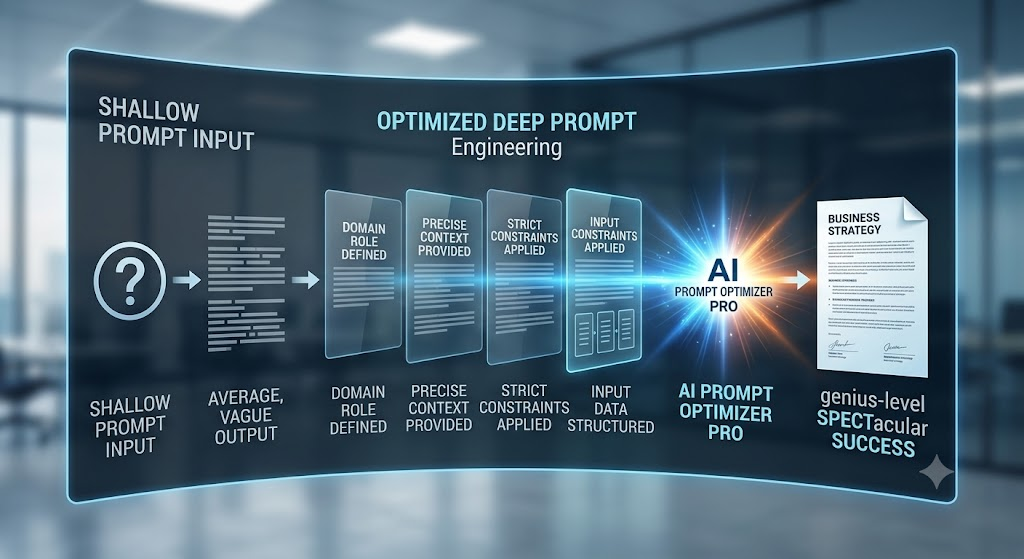
Image #2: Structuring the Intelligence. A visual comparison showing how vague human ideas (Imprecise Input) are structured into defined contextual boundaries by optimization tools, yielding high-quality specific strategies. Optimization is the logic behind consistent success.
Call-to-Action: Stop Wasting AI Potential
If you want the fastest route to professional results, this is the step you cannot skip. Manually constructing these structures for every single interaction can be exhausting. Beginners who require expert output don’t waste time on trial and error. They try our free AI prompt optimizer tool. This powerful generator instantly builds the mandatory personas, constraints, and context into your simple thought automatically, guaranteeing high-quality output on your very first try for ChatGPT, Claude, and Gemini.
What is a Deep Prompt? (The Solution) (H2)
A deep prompt—the mandatory requirement for professional text generation—is an engineered instruction set that treats the Large Language Model like a programmablePredictive engine. You are not “asking” a question; you are engineering a context-bound instruction set.
Your goal with a deep prompt is to narrow the boundary of mathematical freedom. Every constraint and contextual detail you add is a mandate that forces the model to synthesize specific expertise, defined context, strict rules, and structured data into a singular, high-value asset.
The Perfect 5-Part Blueprint of a Deep Prompt (H2)
If you require professional text that requires unique insight, precise business strategy, or definitive expertise, you cannot rely on intuition. You need a structured blueprint. We have decoded the anatomical hierarchy of a perfect instruction set.
To guarantee success, your instruction must contain these five mandatory elements, structured in hierarchy:
1. Persona/Role Definition (Who?)
Establish the specific expert domain. If you require legal analysis, you don’t want a generic blog post; you want a qualified lawyer.
- Weak Persona Input: “Act as a copywriter.”
- Deep Persona Input: “Act as a world-class VP of Sales and Marketing copywriter with 15 years of experience scaling B2B SaaS startups from $1M to $50M ARR.”
2. CORE TASK & OBJECTIVE (What precisely?)
Define the mandatory task using precise action verbs. Vague instruction guarantees vague output.
- Weak Task Input: “Write about B2B sales.”
- Deep Task Input: “Generate an 800-word product launch blog post in English that focuses on identifying enterprise CIO frustration points and pitching our guaranteed 45% reduction in TCO as the solution. The core objective is to get readers to register for a free demo.”
3. COMPREHENSIVE CONTEXT (Where & Why?)
This is where beginners always fail. You must provide the full strategic landscape. What is the background? Who is the audience? What is at stake?
- Weak Context Input: “For our launch.”
- Deep Context Input: “We are targeting analytically minded, Highly intelligent CIOs fatigued by high-cost, SOC2-non-compliant alternatives. Our primary keyword is ‘Enterprise B2B SOC2 SaaS Launch’ and the unique value prop is a guaranteed 45% lower TCO while exceeding all SOC2 standards.”
4. Mandatory Requirements & Strict Constraints (The obligatory rulebook)
This is the mandatory steering wheel. The more you constrain the model, the better the final output. Every constraint elimintes a hallucination or average response.
Mandatory Constraints Checklist:
- Tone: professional, authoritative, analytical, inspirational.
- Length: 1,200 words, 3 sentences, 150 characters.
- Formatting: Structured HTML with H2 Subheadings, JSON data structure, Markdown table.
- Must Include: A quote from the CEO, three customer testimonials, and a highlighted Call-to-Action box.
- Must Avoid: Vague jargon, buzzwords, or first-person references.

Image #3: The Flow of Proven Success. Mastery of the internal logic of AI prompt engineering. An inspired professional successfully organizing knowledge streams by providing strict anatomical boundaries (context, roles, constraints), yielding consistent flows of Creative Content, Specific Strategy, and Proven Solutions.
5. Input Data (The Information Source)
If you are summarizing a legal brief, rewriting meeting notes, or analyzing raw customer feedback, you must clearly separate this input data from your instructions. Use delimiters like XML tags (""" or <<< >>>) to tell the AI, “Only process the information inside these symbols.”
By including all five mandatory elements, you convert a weak, associational query into a robust, infallible engineering blueprint. This forces the mathematical probability map to synthesize specific expertise, defined context, strict rules, and structured data into a singular, high-value asset.
A Message to Our Readers: Demand Spectacular Results Now
Generative AI operates on a mandatory logic: Garbage In, Garbage Out. You are either learning the obligatory structured language required to engineer your context and constraints manually—the mandatory training for professional text generation—or you are accepting the high mathematical probability of receiving generic average output.
If you are ready to stop guessing and start engineering spectacular context on your very first try, you can optimize your prompts for free using AI Prompt Optimizer Pro. This instant engineering generator builds the obligatory blueprints automatically—defining context, roles, and constraints automatically—so you can experience the full productivity potential of AI with zero trial and error. Stop settling for average and start demanding spectacular productivity today.
Pro Tips vs. Common Mistakes in Prompt Engineering (H2)
Talking to AI is not intuitive. It requires a specific declarative logic. Master prompt engineering by avoiding these common traps:
Common Mistakes to Avoid (The “Garbage In”)
- ❌ Treating AI Like Google: Google wants to assoicate. AI wants to be programmed with context. Never use search bar keywords; use strict declarative instructions.
- ❌ Being Polite or Flowery: AI models lack feelings but get easily confused by subtext. Be imperative, declarative, and clear. Correction: “Rewrite this section to be exactly 300 words with no bullet points.”
- ❌ Mixing instructions and raw data: Always use delimiters like triple quotes
"""to separate what the AI must do from the data it must analyze.
Pro Tips for Success (The “Master Class”)
- Iterative Feedback: Your first prompt is just the blueprint. Use the dialogue to refine, critique, and improve the output. Correction: “I love section 1, but section 2 is too professional. Rewrite it to sound more conversational and humorous, aimed at college students.”
- Instance optimization: Skip the engineering curve when you can. For important tasks, guarantee professional logic by using a dedicated generator that automatically implements perfect structural design for you. Master prompt engineering by learning the blueprint, but always remember you can enhance your ChatGPT prompts instantly by converting your simple thought into a structurally sound engineering blueprint instantly.
The Imperative Hierarchy Checklist (H2)
The most transformative technology of our lifetime requires a specific logical language to unlock its potential. Learning the internal architecture of context, context-bound engineering, constraints, and deliberate hierarchy—the obbligatory skills required to write successful deep prompts—is the compulsory training for anyone utilizing AI for professional output.
Follow this imperative checklist for every critical task:
- Define Domain Expertise: Who must the AI be?
- State Precise Context: Why are we doing this and what’s at stake?
- State Mandatory Core Task: Define precisely with a strict action verb.
- Set Mandatory Constraints: Tone, length, formatting, must-includes.
- Separate Raw Input Data: Use delimiters (
""") to avoid confusion. - Demand Exact Output Structure: How should the final asset be formatted?
- Critique and Iterate: Do not accept the first draft. Provide feedback for refinements.
By following this obligatory checklist and utilizing instant optimization intelligence when necessary, you turn AI productivity frustration into infalliable success. Stop guessing. Start engineering.
Unlock Spectacular Results Now: Try Our Free AI Prompt Optimizer
Why wait? You know exactly what a shallow prompt is and why structure is obligatoire. Put that new knowledge to the mandatory test right now.
Optimize your prompts for free using AI Prompt Optimizer Pro. It’s instant, 100% free, and requires no credit card. Turn your generic, simple thought into a structurally perfect engineering instruction blueprint for ChatGPT, Claude, and Gemini in one click. Experience espectacular AI potential like never before—with zero trial and error.